


CODE EYE CARE

How Does Diabetes Affect
the Eyes and Vision?

Understanding the changes you can’t always feel

GI
Medical Director, CODE Eye Care
On this page

“Doctor, my eyesight is perfectly fine. Why did my diabetologist send me for an eye check-up?”

I hear this question often in my practice, usually from someone whose son or daughter insisted on the visit.

That reaction is understandable. If you can read the newspaper, an eye test feels unnecessary.

But clear vision today does not always mean healthy eyes.

That is why “how does diabetes affect the eyes and vision” is one of the most useful questions a person with diabetes can ask. Below, I explain what changes inside the eye, why these changes are often silent, and how you can protect your sight.

★
QUICK ANSWER

How does diabetes affect the eyes and vision? Diabetes mainly damages the tiny blood vessels of the retina, the light-sensitive layer at the back of the eye, causing diabetic retinopathy. Diabetes also raises the risk of cataract, glaucoma, dry eye and blurred vision from sugar swings. Early damage is often silent, so a yearly dilated eye exam is recommended.

QUICK FACTS
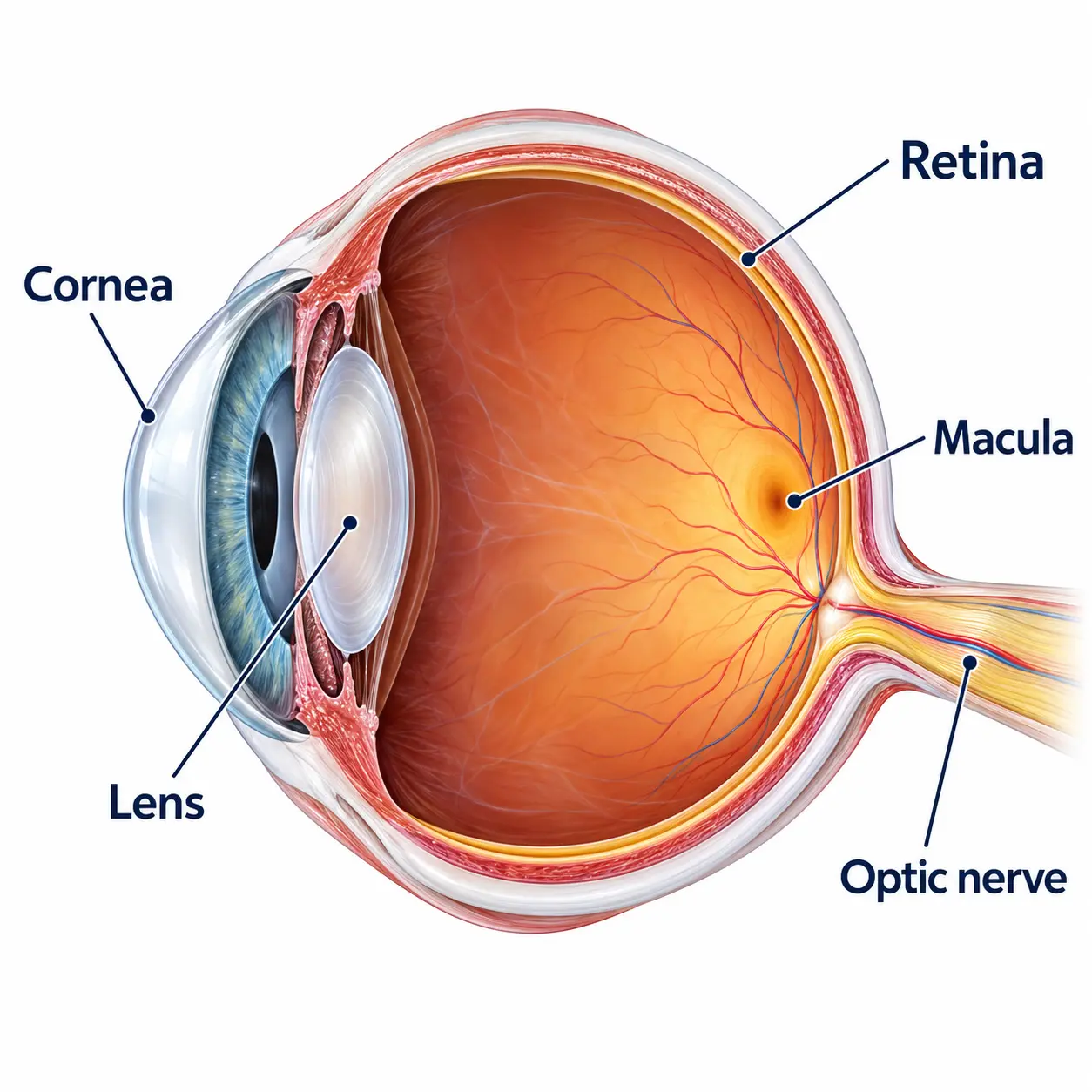
Eye anatomy diagram labelling the cornea, lens, retina, macula and optic nerve
THE BASICS

How Does Diabetes Affect the Eyes and Vision?

Diabetes affects the eyes and vision mainly by damaging the tiny blood vessels of the retina, the light-sensitive layer at the back of the eye. It can also affect the lens, the optic nerve and the eye’s surface.

This matters in India. A national ICMR study of over one lakh people found diabetes in 11.4%. So diabetes and eyes is a concern that touches many families.

Diabetes can affect almost every part of the eye:

When the retina is involved, care may include retina treatment and surgery, planned together with your diabetes physician.

To see how one condition reaches so many parts of the eye, we need to start with the blood vessels.

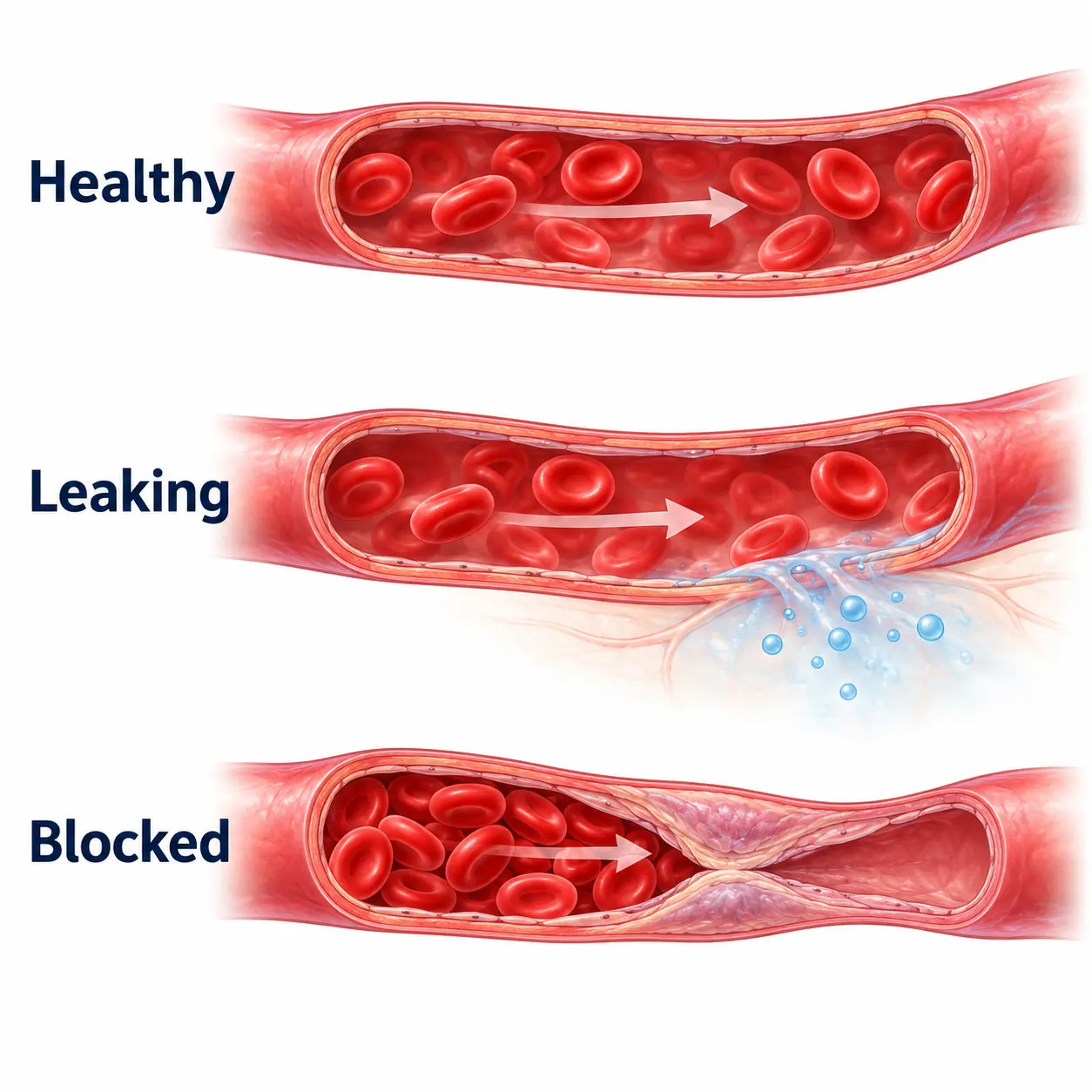
Illustration of healthy, leaking and blocked blood vessels showing how high blood sugar changes blood flow
THE CAUSE

Why Does High Blood Sugar Damage the Eyes?

High blood sugar damages the eyes because, over years, excess glucose harms the walls of small blood vessels in the retina. These weakened vessels can swell, leak fluid or blood, or close off completely. Parts of the retina are then left short of oxygen.

Think of these vessels like the old water pipes in an apartment building. Some joints start to drip, while other pipes slowly block up. In the eye, both cause trouble.

The retina may then grow new blood vessels. But these are fragile, bleed easily and can form scar tissue.

Time matters too. The risk rises the longer you have diabetes, whether it is type 1, type 2 or gestational diabetes.

These leaks and blockages have a name, and it is the condition I am asked about most.

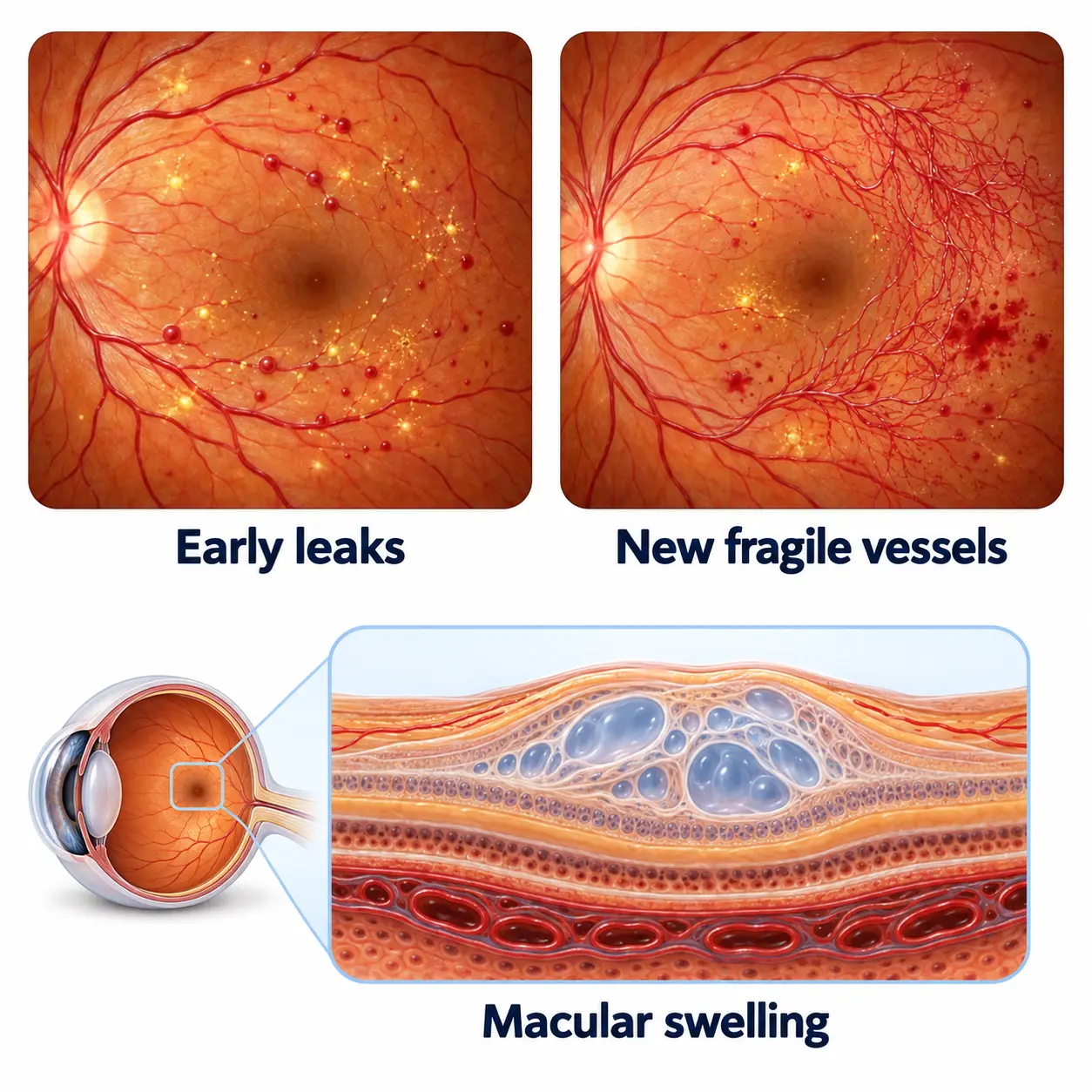
Diabetic retinopathy illustration showing early leaks, new fragile blood vessels and macular swelling
INSIDE THE EYE

What Is Diabetic Retinopathy?

Diabetic retinopathy is an eye condition in which diabetes damages the blood vessels of the retina, and it can cause vision loss and blindness. It develops in stages, and the early stages rarely cause symptoms.

01

Non-proliferative diabetic retinopathy (NPDR)

This is the early stage. Tiny blood vessels leak, and the retina may swell. Most people notice nothing.

02

Proliferative diabetic retinopathy (PDR)

This is the advanced stage. The retina grows new, abnormal blood vessels that can bleed into the vitreous, the clear gel inside the eye. PDR can affect both central and side vision.

Diabetic macular oedema

Diabetic macular oedema (DME) is swelling of the macula, the small central part of the retina used for reading and recognising faces. It happens when leaky vessels let fluid collect there. Over time, about 1 in 15 people with diabetes will develop DME.

It is a little like wallpaper that bubbles when damp seeps in behind it. The picture is still there, but it looks wavy. That is why DME often blurs or bends reading vision.

At this point, patients usually ask me the same thing. If all this is happening, why didn’t they notice?

Older man reading a newspaper with a retina illustration, showing that early diabetic eye damage can be silent
EARLY SIGNS

“Doctor, If My Eyes Were Damaged, Wouldn’t I Know?”

Not always. The early stages of diabetic retinopathy usually cause no symptoms. A person can read, drive and watch TV normally while damage is already developing in the retina.

This is one of the biggest misconceptions I discuss with my patients. Retinal damage does not hurt.

Silence is not the same as safety.

As the disease progresses, you may notice:

!
IMPORTANT

A sudden shower of floaters, a dark curtain across your vision or sudden loss of vision needs urgent assessment the same day. This applies even if there is no pain.

The retina gets most of the attention, but diabetes affects more than just the retina.

BEYOND THE RETINA

Can Diabetes Cause Cataract, Glaucoma and Double Vision?

Yes. Diabetes raises the risk of cataract and glaucoma. It can also cause sudden double vision by affecting the small nerves that move the eyes.

Cataract

A cataract is clouding of the eye’s natural lens. People with diabetes are 2 to 5 times more likely to develop cataracts, and at a younger age. Before any cataract surgery, we check the retina carefully, because macular swelling needs attention first. You can also read about whether cataract can be treated without surgery.

Glaucoma

Glaucoma is a group of diseases that damage the optic nerve, the cable that carries images to the brain. Diabetes nearly doubles the risk of open-angle glaucoma. Our article on what causes glaucoma explains who else is at risk.

Double vision

Double vision can come from microvascular cranial nerve palsy, where tiny vessels feeding an eye muscle nerve are affected. It almost always settles on its own, but it needs prompt examination because similar signs can point to serious conditions.

Another question I hear frequently is about vision that changes from one day to the next.

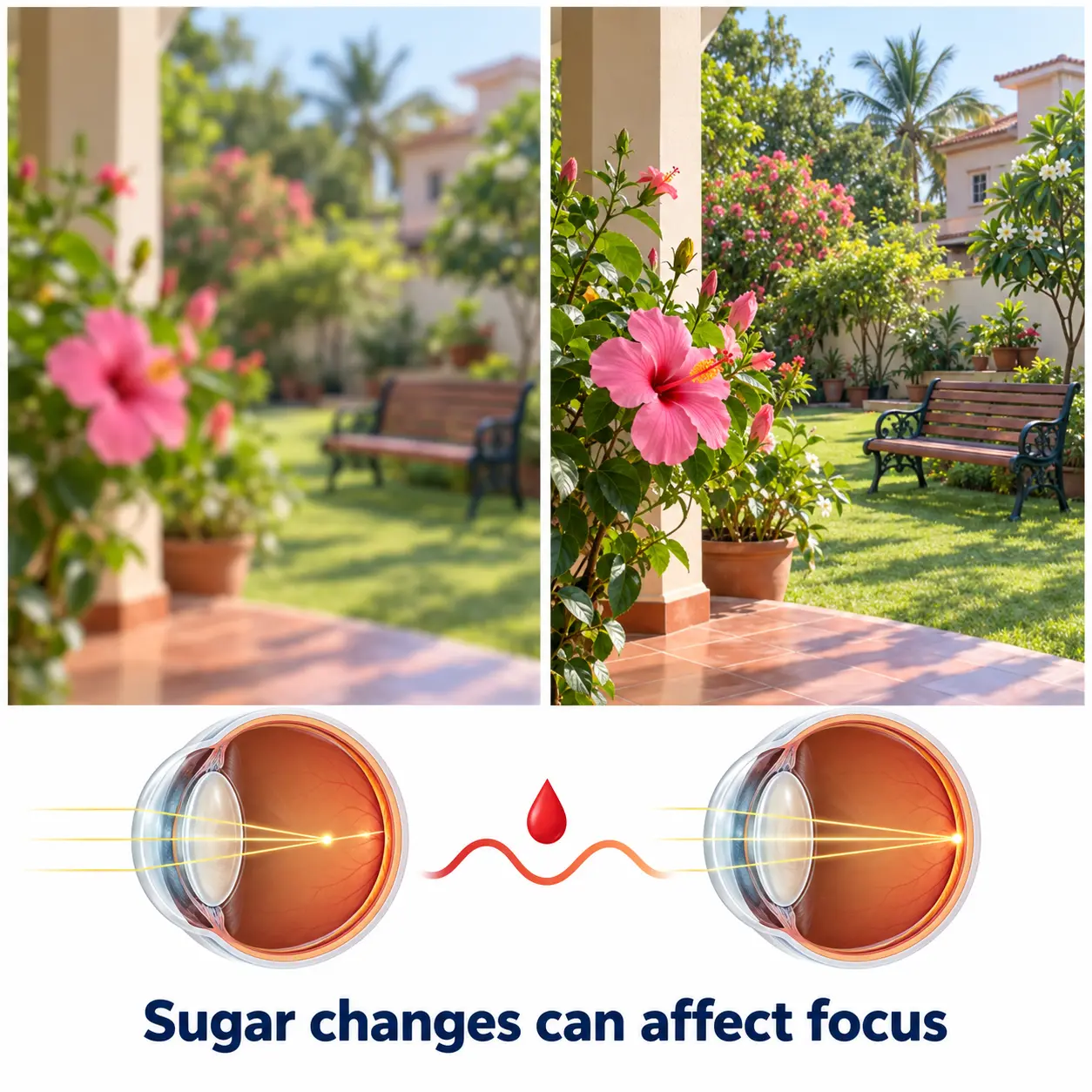
Blurred and clear views of the same garden showing how blood sugar changes can affect focus
DAY-TO-DAY BLUR

“Doctor, Why Does My Vision Blur When My Sugar Goes Up and Down?”

Blurred vision in diabetes can happen when blood sugar changes quickly, because the change alters the shape of the eye’s lens. According to the American Academy of Ophthalmology, this blur usually settles once blood sugar is stable.

Think of a camera lens that keeps slipping out of focus. The camera is not broken, but every photo looks soft until the lens settles.

So I advise patients not to rush for new glasses right after changing diabetes treatment. A prescription measured during a sugar swing may not suit you later.

But not every blur is a sugar swing. Blur that does not settle, or blur in one eye only, needs an examination.

Blur from sugar swings starts in the lens. Some of the discomfort people with diabetes feel starts even further forward, on the eye’s surface.

Illustration of a dry eye surface with slower healing and reduced corneal sensitivity
THE SURFACE

Can Diabetes Cause Dry Eyes and Corneal Problems?

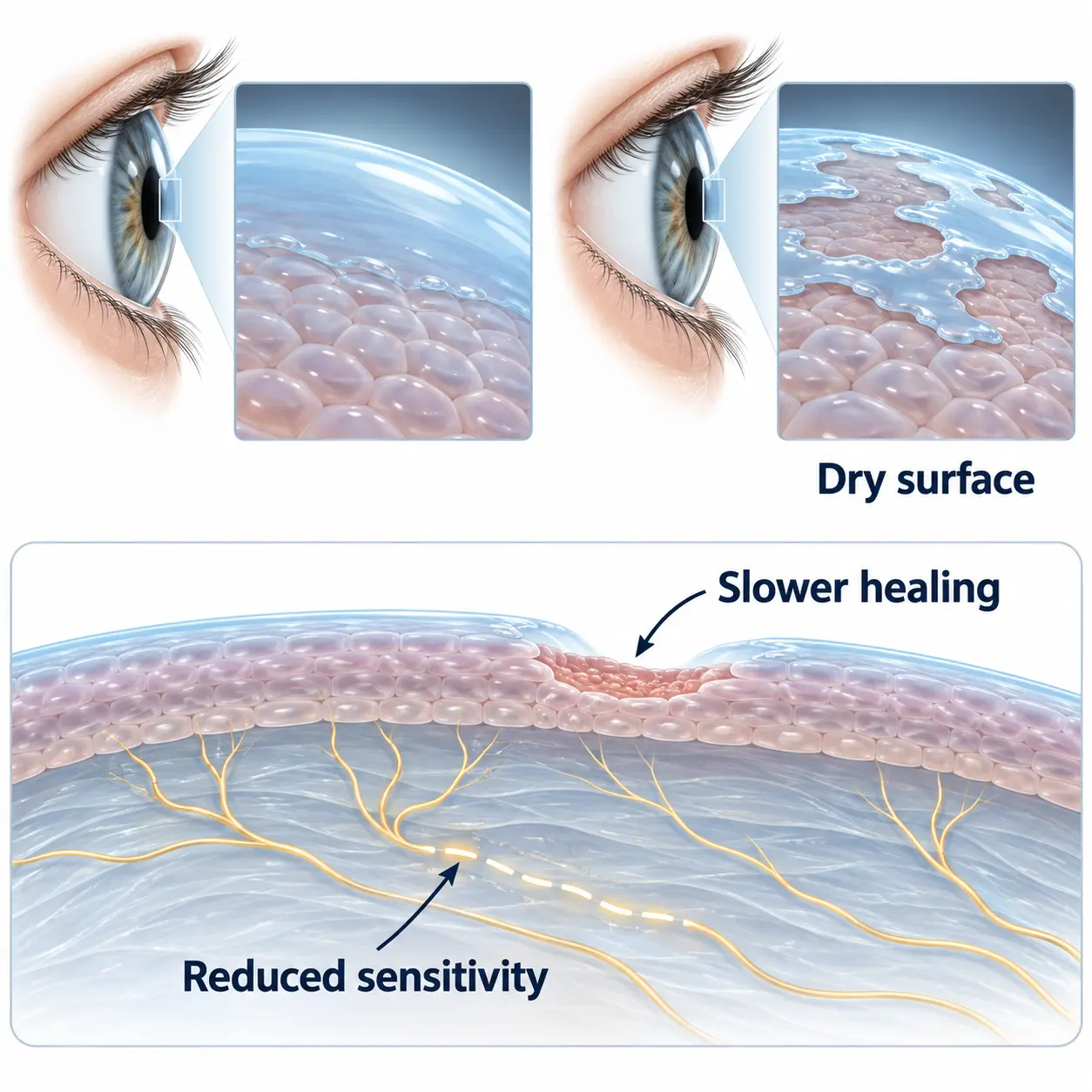
Yes. Diabetes increases the risk of dry eye and can weaken the nerves of the cornea, the clear front window of the eye. This can reduce the eye’s sensitivity and slow the healing of small surface injuries.

This is close to my own work as a cornea specialist. A systematic review found that eyes affected by diabetes have a higher risk of dry eye, recurrent corneal erosions and slow-healing surface wounds.

Reduced corneal sensation is a bit like a smoke alarm with a weak battery. The danger is still there, but the warning is quieter. So the eye may feel less discomfort than the problem deserves.

That is why I watch the ocular surface closely, especially in contact lens users and before eye surgery. If burning or grittiness bothers you, read our article on understanding and managing dry eye.

“

“An eye that feels comfortable is not always an eye that is healthy. In diabetes, the warning signals can be quieter than the problem.”

Dr Geetha Iyer, Medical Director, CODE Eye Care, Chennai

Because so many of these changes are silent, the eye examination becomes the most useful tool we have.

Diabetic eye exam steps: vision test, eye pressure check, front of eye exam, retina exam and OCT scan
FINDING DIABETIC EYE DISEASE

What Happens During a Diabetic Eye Exam?

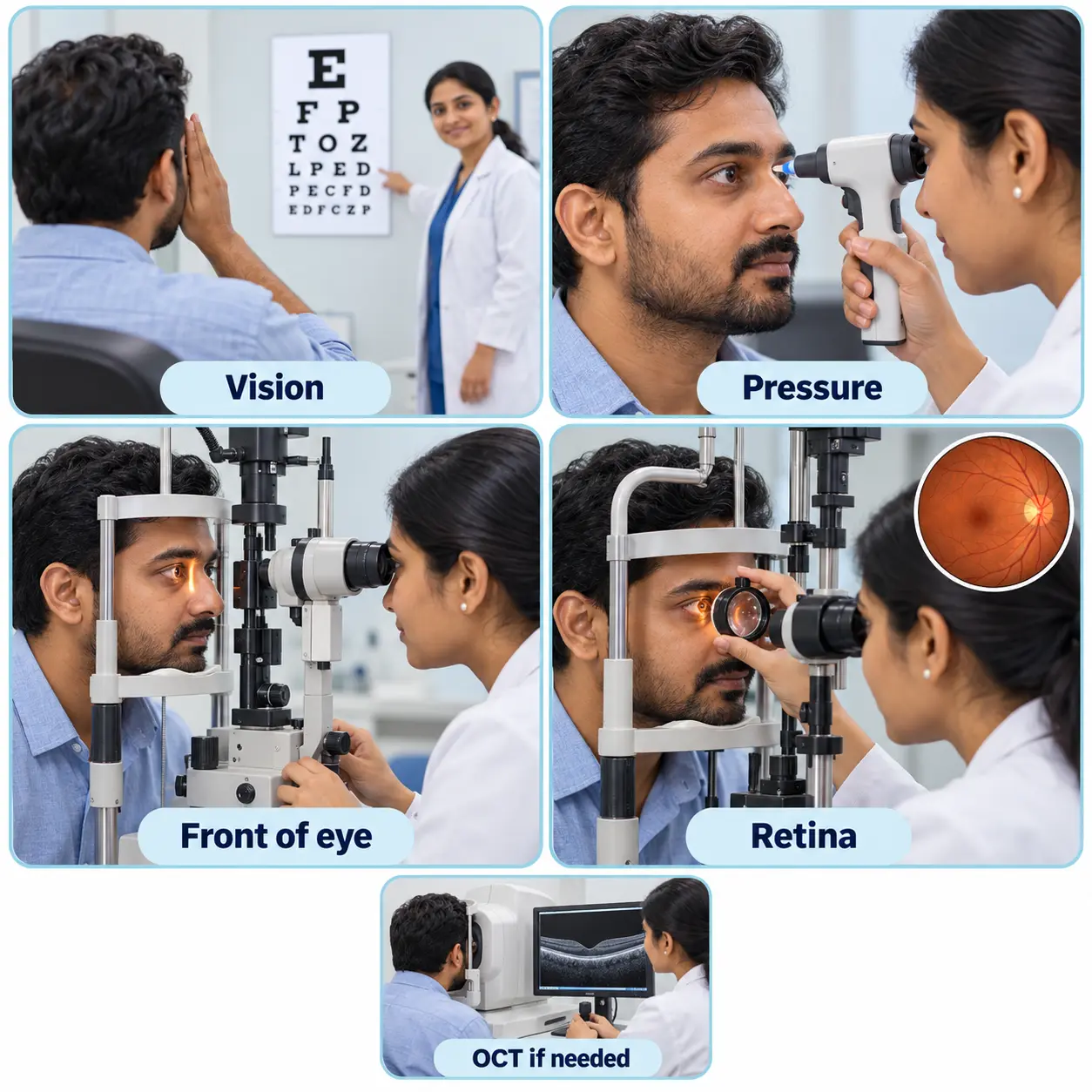
A diabetic eye exam is a detailed check of the whole eye, including a dilated retinal exam. Drops widen the pupil so the doctor can see the back of the eye. The exam is painless, though vision stays blurred for a few hours.

We first look at what’s happening inside the eye. We usually check:

When needed, we add optical coherence tomography (OCT), a painless scan that shows swelling in the retina.

The National Eye Institute advises a dilated eye exam at least once a year for people with diabetes. If you are pregnant and have diabetes, get checked as soon as possible. You can read more on why routine eye examinations matter.

Once diabetic eye disease is found, timing matters. Treatment works well before vision is badly affected.

Diabetic eye disease treatment options: diabetes control, eye injections, laser and surgery
THE APPROACH

How Is Diabetic Eye Disease Treated?

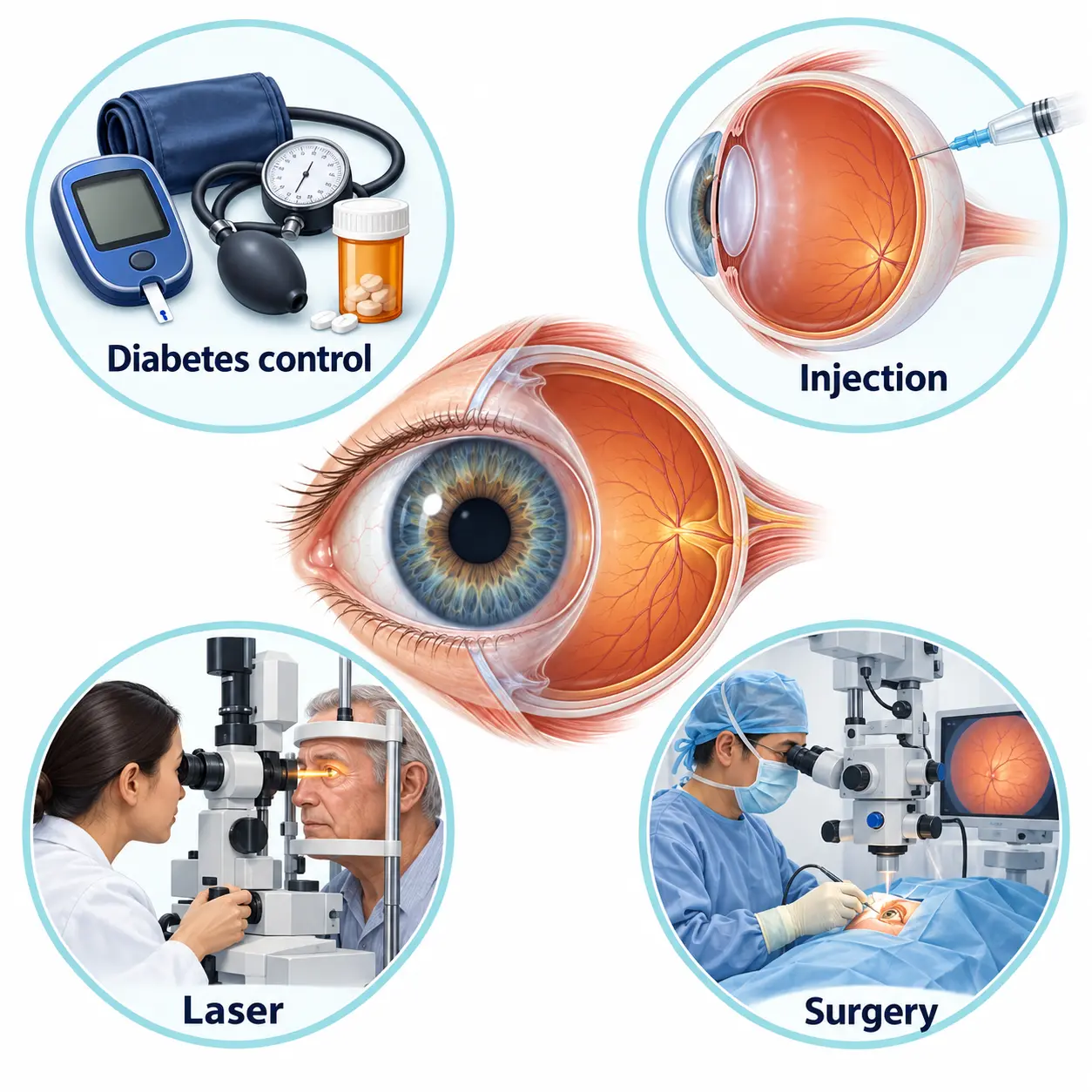
Diabetic eye disease is treated on two fronts. Your physician helps control blood sugar, blood pressure and cholesterol, while your eye doctor treats the eye with injections, laser or surgery when needed. The choice depends on the stage of disease and where the damage is.

There is no one-size-fits-all plan. We consider whether the macula is swollen, whether new vessels have formed, and whether there is bleeding.

01

Diabetes control

Good control of sugar, blood pressure and cholesterol lowers the risk of vision loss. Never stop or change diabetes medicines without your doctor.

02

Anti-VEGF injections

Medicines injected into the eye to reduce leakage and abnormal vessel growth.

03

Laser treatment

Used to reduce swelling and control abnormal vessels.

04

Vitrectomy

Surgery to remove blood or scar tissue from the gel inside the eye.

Treatment can do a great deal, but it is important to be clear about what it cannot do.

Older woman reading a book with her daughter, a reminder that treatment protects remaining vision
TREATMENT LIMITS

Can Diabetic Eye Damage Be Reversed?

Not always. Treatment for diabetic retinopathy can stop vision from getting worse, but it usually cannot undo damage that has already happened. Some vision may improve as swelling settles, but this varies from person to person.

Treatment is also rarely a one-time event. Follow-up often continues for years.

“Doctor, my vision is better now. Can I stop coming?”

Not without discussing it with your eye doctor. The disease can become active again, even after it has settled.

★
KEY MESSAGE

“Treatment protects the vision you still have. That is why finding diabetic eye disease early makes such a difference.”

The encouraging part is that much of the protection happens outside the clinic, in your daily routine.

Ways to protect your eyes with diabetes: manage sugar, check blood pressure and cholesterol, stay active and get eye checks
PREVENTION

How Can You Protect Your Eyes If You Have Diabetes?

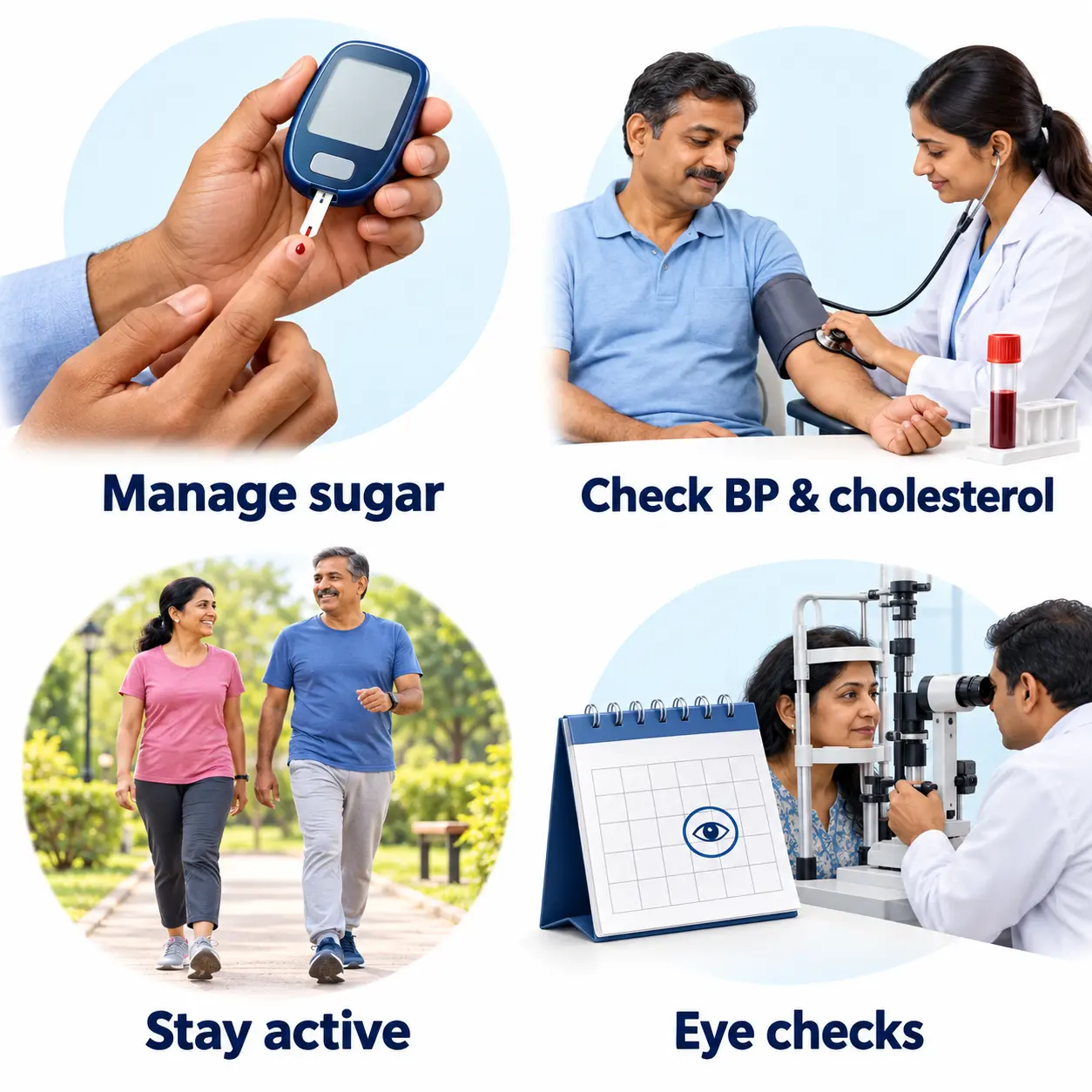
You can protect your eyes by managing blood sugar, blood pressure and cholesterol. Just as important, have a dilated eye exam at least once a year, even when your vision feels normal.

A few practical steps I share with my patients:

“

“I would much rather examine your eyes and tell you that everything looks healthy than meet you after vision has already been lost.”

Dr Geetha Iyer, Medical Director, CODE Eye Care, Chennai

Families usually have a few more practical questions before they leave the room. These are the ones I hear most.

ANSWERS

What Do Patients Commonly Ask About Diabetes and Eyes?

Can diabetes cause blindness?

Yes. Diabetes can cause blindness if diabetic retinopathy or diabetic macular oedema is not found and treated in time. A yearly dilated eye exam, good control of sugar, blood pressure and cholesterol, and timely treatment all lower the risk of serious vision loss.

At least once a year. People with diabetes should have a comprehensive dilated eye exam every year, even if their vision seems normal. Your eye doctor may advise more frequent visits if diabetic retinopathy is found, or during pregnancy.

Yes. Good sugar control lowers the risk of diabetic eye disease, but it does not remove it. Diabetic retinopathy can develop quietly, and the risk rises the longer you have diabetes. A yearly dilated eye exam is still recommended, even when your reports look good.

Not necessarily. If the blur comes from a recent swing in blood sugar, it usually settles once sugar is stable. Glasses measured too early may not suit you later. Blur that persists should be examined, because cataract or macular swelling may be the cause.

Not usually. Numbing drops are used before eye injections and laser, and many people describe pressure rather than sharp pain. Vitrectomy is done under anaesthesia. Your eye doctor will explain what to expect beforehand.

GI

A Note from Dr Geetha Iyer

Medical Director, CODE Eye Care, Chennai

“In my practice, many people with diabetes come only when something feels wrong. By then, retinal changes may have been building for years.”

The most common mistake I see is waiting for symptoms. Diabetic eye disease rarely announces itself early.

So I tell my patients to treat the yearly eye check-up the same way they treat their HbA1c test. It is part of diabetes care, not an extra.

I also want to be clear about limits. Treatment cannot always restore lost vision. But it can protect what you still have, and that matters for reading, driving and independence.

Don’t spend too much time worrying about what might be happening inside your eyes. Instead, ask yourself, “When was my last dilated eye exam?” If you can’t remember, that is your next step.

THE TAKEAWAY

Final Thoughts

If you’ve searched “how does diabetes affect the eyes and vision,” you are probably hoping for a simple answer.

The simple answer is that diabetes can affect almost every part of the eye, often quietly and without pain.

The encouraging part is that you are not powerless. Steady sugar, blood pressure and cholesterol control, plus a yearly dilated eye exam, give you a strong chance of catching changes early.

Your eyes may not warn you, so let a yearly eye check do it for them.
WHEN TO VISIT

When Should Someone with Diabetes See an Eye Doctor?

Please see an eye doctor if you notice lasting blur, new floaters, dark spots, double vision, a droopy eyelid or persistent grittiness.

These should not simply be dismissed as “just sugar”. And don’t wait for symptoms at all.

At CODE Eye Care, we explain what we find in plain language and plan the next steps with you.

If you are looking for a diabetic eye check-up in Chennai, you can book an appointment with our team.

Last reviewed: October 2026 by Dr Geetha Iyer, Medical Director, CODE Eye Care, Chennai

This article is for general information and does not replace a personal eye examination.

Related patient education
More from CODE Insights.
What Causes Glaucoma? Understanding Why It Develops and Who Is Most at Risk?

What Causes Glaucoma? Understanding Why It Develops and Who Is Most…

Home › Patient Education › What Causes Glaucoma? What Causes Glaucoma?Understanding Why It Develops and Who Is Most at Risk […]
Can Cataract Be Cured Without Surgery?

Can Cataract Be Cured Without Surgery?

Home › Patient Education › Can Cataract Be Cured Without Surgery? GI Reviewed by Dr Geetha Iyer Medical Director, CODE […]

Dry Eye? You’re Not Alone: Understanding and Managing This Common Condition

Dry Eye? You’re Not Alone: Understanding and Managing This Common Condition

Dry Eye? You’re Not Alone: Understanding and Managing This Common Condition DeCODE Dry Eye EnCODE Relief​ Meet Priya, a talented […]

Scroll to Top

Book an Appointment

Contact us