Myopia Treatment in Chennai
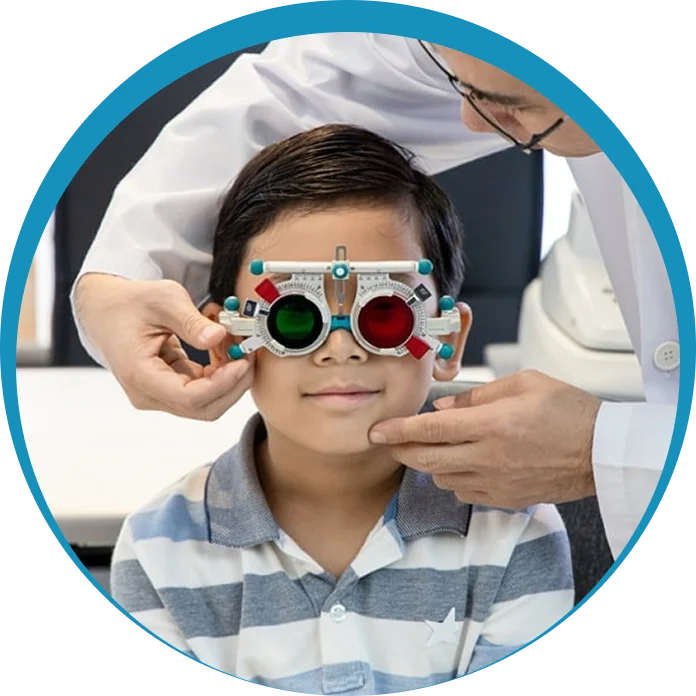
Myopia, commonly called nearsightedness, is a condition where distant objects appear blurred while near objects remain clear. It occurs when the eye grows longer than normal or when the cornea bends light too strongly, causing light to focus in front of the retina instead of directly on it.
While glasses or contact lenses can correct the blur, myopia is not always a static condition. In many patients, especially children, it can continue to progress over time. High or rapidly progressing myopia can increase the lifetime risk of retinal detachment, glaucoma, and myopic macular degeneration.
At CODE Eye Care, myopia treatment is approached as long-term eye health management rather than just vision correction. Our focus is on identifying the cause, carefully monitoring progression, and selecting treatments that protect the eye over the long term, particularly in children and young adults whose eyes are still developing.

Why Does Myopia Develop?
Myopia usually begins during school years and may worsen during adolescence. Several factors contribute to its development.
Genetics plays a strong role. Children with one or both parents who are myopic are significantly more likely to develop it.
Environmental factors are also important. Prolonged near-work, such as reading, computer use, or screen time, can contribute to progression, particularly when combined with limited outdoor activity.
Structural factors in the eye also play a role. In some individuals, the eyeball grows longer than normal, while in others the cornea may have a steeper curvature.
At CODE Eye Care, understanding why myopia is progressing in a particular patient helps guide the most effective treatment strategy.
When Should Myopia Be Treated Rather Than Just Corrected?
Many patients assume glasses alone are sufficient. However, simple vision correction does not slow the underlying progression of myopia.
Myopia begins early in childhood
The prescription increases rapidly each year
The eye length is growing excessively
There is a family history of high myopia
The patient already has moderate or high myopia
In children, early intervention can significantly reduce the risk of high myopia later in life.
At CODE Eye Care, we evaluate not only the glasses number but also axial eye length, corneal health, and retinal status before recommending treatment.
What Myopia Treatments in Chennai Does CODE Eye Care Offer?
Modern myopia management involves several approaches. The right option depends on the patient’s age, eye structure, and rate of progression.
For children with progressive myopia, treatment focuses on slowing the rate of eye growth.
Options may include:
Low-dose atropine therapy
Orthokeratology (Ortho-K lenses)
Myopia control spectacle lenses or contact lenses
At CODE Eye Care, treatment plans for children are individualised. We carefully monitor changes in axial length and prescription over time to ensure the therapy is working.
Adults who have stable myopia may consider myopia surgery to reduce dependence on glasses or contact lenses.
Common options include:
LASIK
SMILE (Small Incision Lenticule Extraction)
Phakic IOL (Implantable Contact Lens)
At CODE Eye Care, we do not recommend surgery unless the eye meets strict safety criteria. Our treatment decisions are guided by corneal thickness, corneal shape stability, tear film health, retinal status, and long-term visual safety.
For children with progressive myopia, treatment focuses on slowing the rate of eye growth.
Options may include:
Low-dose atropine therapy
Orthokeratology (Ortho-K lenses)
Myopia control spectacle lenses or contact lenses
At CODE Eye Care, treatment plans for children are individualised. We carefully monitor changes in axial length and prescription over time to ensure the therapy is working.
Adults who have stable myopia may consider myopia surgery to reduce dependence on glasses or contact lenses.
Common options include:
LASIK
SMILE (Small Incision Lenticule Extraction)
Phakic IOL (Implantable Contact Lens)
At CODE Eye Care, we do not recommend surgery unless the eye meets strict safety criteria. Our treatment decisions are guided by corneal thickness, corneal shape stability, tear film health, retinal status, and long-term visual safety.
How Do We Evaluate Myopia at CODE Eye Care?
Accurate evaluation is essential before recommending any treatment.
A comprehensive myopia assessment typically includes:
- Advanced corneal topography
- Measurement of axial eye length
- Retinal examination for early myopic changes
- Tear film and ocular surface assessment
- Refraction and visual performance testing
This detailed evaluation allows us to determine whether the patient needs progression control, vision correction, or surgical treatment.
At CODE Eye Care, we approach myopia as a structural eye condition that requires careful monitoring over time, especially in children and patients with high myopia.
What Are the Risks of High Myopia?
When myopia becomes severe, it can lead to structural changes in the back of the eye.
- Retinal detachment
- Myopic macular degeneration
- Glaucoma
- Early cataract formation
These risks are why myopia management is increasingly considered preventive eye care rather than just a form of vision correction.
In our experience with advanced myopia, early monitoring and intervention can significantly reduce the risk of these complications.
Can Myopia Be Permanently Cured?
Myopia cannot be reversed once the eye has grown longer. However, its progression can often be slowed, and vision can be corrected safely.
Surgical procedures can reduce or eliminate the need for glasses after the age of 18, but they do not change the underlying eye length. For this reason, long-term monitoring remains important even after surgery.
At CODE Eye Care, we focus on helping patients maintain stable vision and healthy eyes throughout their lives, not just on correcting their prescription.
When Should You See a Myopia Doctor?
- A child’s glasses number increases every year
- Blurred distance vision develops suddenly
- Myopia exceeds −5.00 or continues progressing in adulthood
- There is difficulty tolerating glasses or contact lenses
- You are considering myopia surgery
Early evaluation allows us to determine whether active treatment is needed.
Our Approach to Myopia Treatment in Chennai
At CODE Eye Care, myopia care is guided by careful diagnosis and long-term vision preservation.
We approach each patient differently depending on age, risk factors, and disease progression.
For children, the priority is to slow eye growth and prevent high myopia.
For adults, the focus is safe visual correction while protecting corneal and retinal health.
Most importantly, we believe surgery should only be recommended when it is clearly safe and appropriate. If non-surgical options provide better long-term outcomes, those are prioritised.
This careful, evidence-based approach allows us to manage both routine and complex cases of myopia with confidence.
Take the Next Step
If you are concerned about progressive nearsightedness or would like to explore advanced myopia treatment options, the specialists at CODE Eye Care can evaluate your eyes and guide you toward the safest long-term solution. For appointments or consultations, please visit our Contact Us page.