CODE EYE CARE

Do We Need Glasses
After Cataract Surgery?

What your lens choice really means

GI
Medical Director, CODE Eye Care
dcbdf064c0205b1443f8407d78a6eadc
On this page

“Doctor, after the operation, can I finally throw away my glasses?”

I hear this in almost every cataract consultation. Sometimes the patient asks. More often, it’s the son or daughter sitting beside them.

It’s a fair hope. Many people have worn glasses for decades, and surgery feels like a fresh start.

The truth is more complex.

So, do we need glasses after cataract surgery? Many people do, at least for some tasks. How much depends on the lens placed in your eye, your eye health and your daily habits. Let me explain what decides it, and what you can realistically expect.

★
QUICK ANSWER

Do we need glasses after cataract surgery? Many people still do, at least for some tasks. With a standard monofocal lens set for distance, most people need reading glasses. Multifocal and extended depth of focus (EDOF) lenses can reduce the need for glasses. But no lens can promise complete freedom from glasses, and some cause glare at night.

QUICK FACTS
THE SHORT ANSWER

Will You Still Need Glasses After Cataract Surgery?

It depends. Most people still need glasses after cataract surgery for at least some tasks, usually reading, because a standard lens focuses at one distance. Special lenses can reduce that need. But your lens type, eye health and daily habits together decide how often you reach for glasses.

I often remind my patients that cataract surgery has two goals. The first is to remove the cloudiness. The second is to set the focus of the new lens.

Before surgery, no pair of glasses could clear the fog of a cataract. After surgery, the fog is gone. If you need them, glasses only fine-tune the focus.

So I explain that clear vision and glasses-free vision are not the same thing.

But why should a new lens change your glasses at all? To understand that, it helps to know what your natural lens used to do.

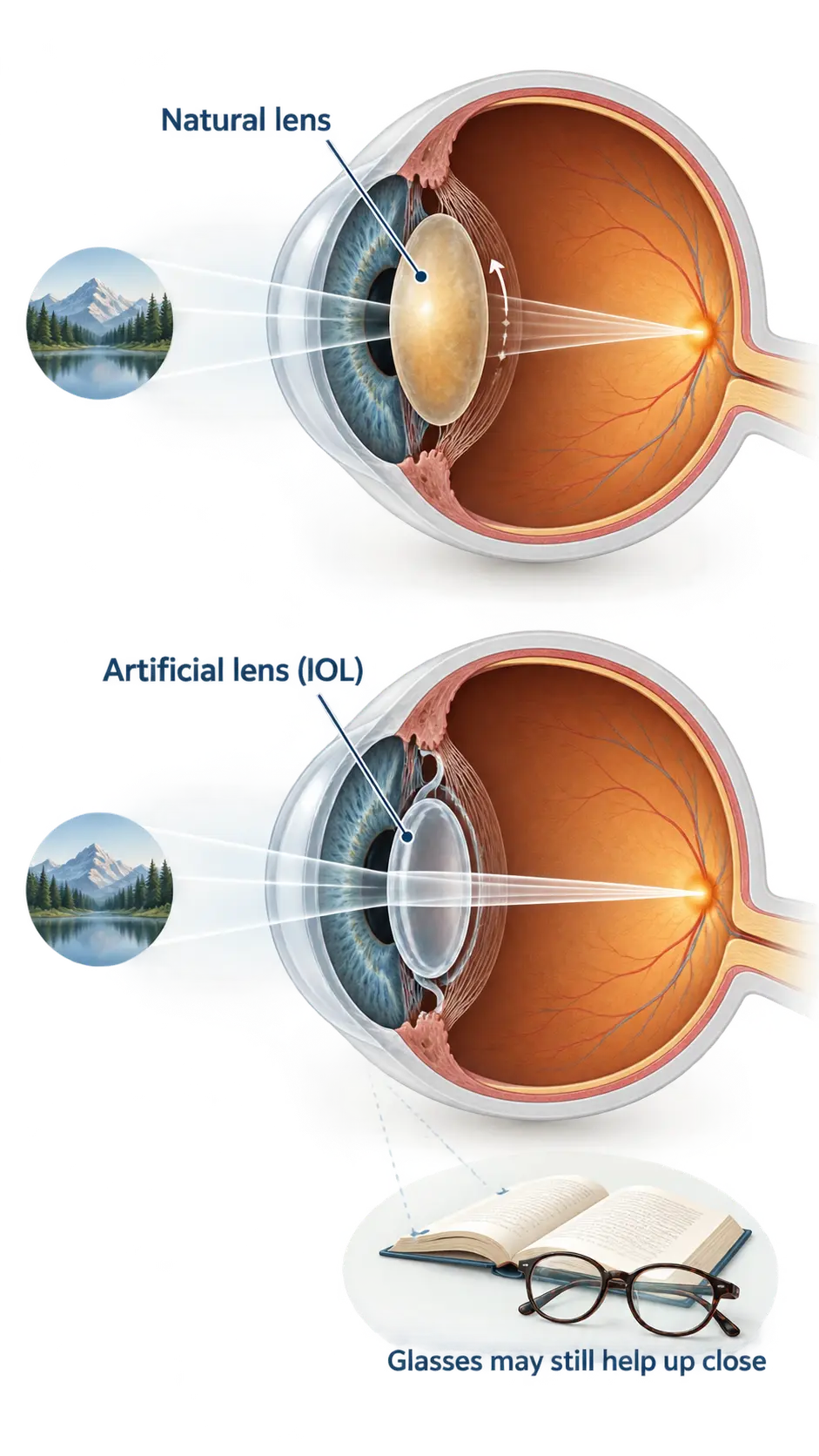
Eye diagram comparing the natural lens and artificial intraocular lens (IOL), showing how vision is focused on the retina and why glasses may still be needed for near vision
THE BASICS

Why Does Cataract Surgery Change Your Glasses Prescription?

Cataract surgery changes your glasses prescription because the lens that focuses light inside your eye is replaced. The new lens, called an intraocular lens (IOL), has a fixed power chosen before surgery. That power decides whether you see clearly far away, up close, or both.

When you are young, your natural lens changes shape to shift focus from far to near. With age, it stiffens and loses this ability. This is called presbyopia, and it’s why most people need reading glasses in middle age.

A cataract is a clouding of that same lens. During cataract surgery, the cloudy lens is removed through a small opening, and a foldable artificial lens takes its place.

A standard IOL works like a camera lens fixed at one distance. It gives a sharp picture at its set distance, but it cannot zoom by itself.

So something else has to handle the other distances. Usually, that something is a pair of glasses.

But not every IOL is designed the same way, and this is where your lens choice matters most.

YOUR LENS OPTIONS

How Does Your Lens Choice Affect Glasses After Cataract Surgery?

Your lens choice is the main factor in how much you need glasses after cataract surgery. A monofocal lens usually means reading glasses. A toric lens reduces the need for glasses for astigmatism. Multifocal and EDOF lenses aim to reduce glasses at multiple distances, though they come with trade-offs.

Here is how each lens type works, and what it means for your glasses.

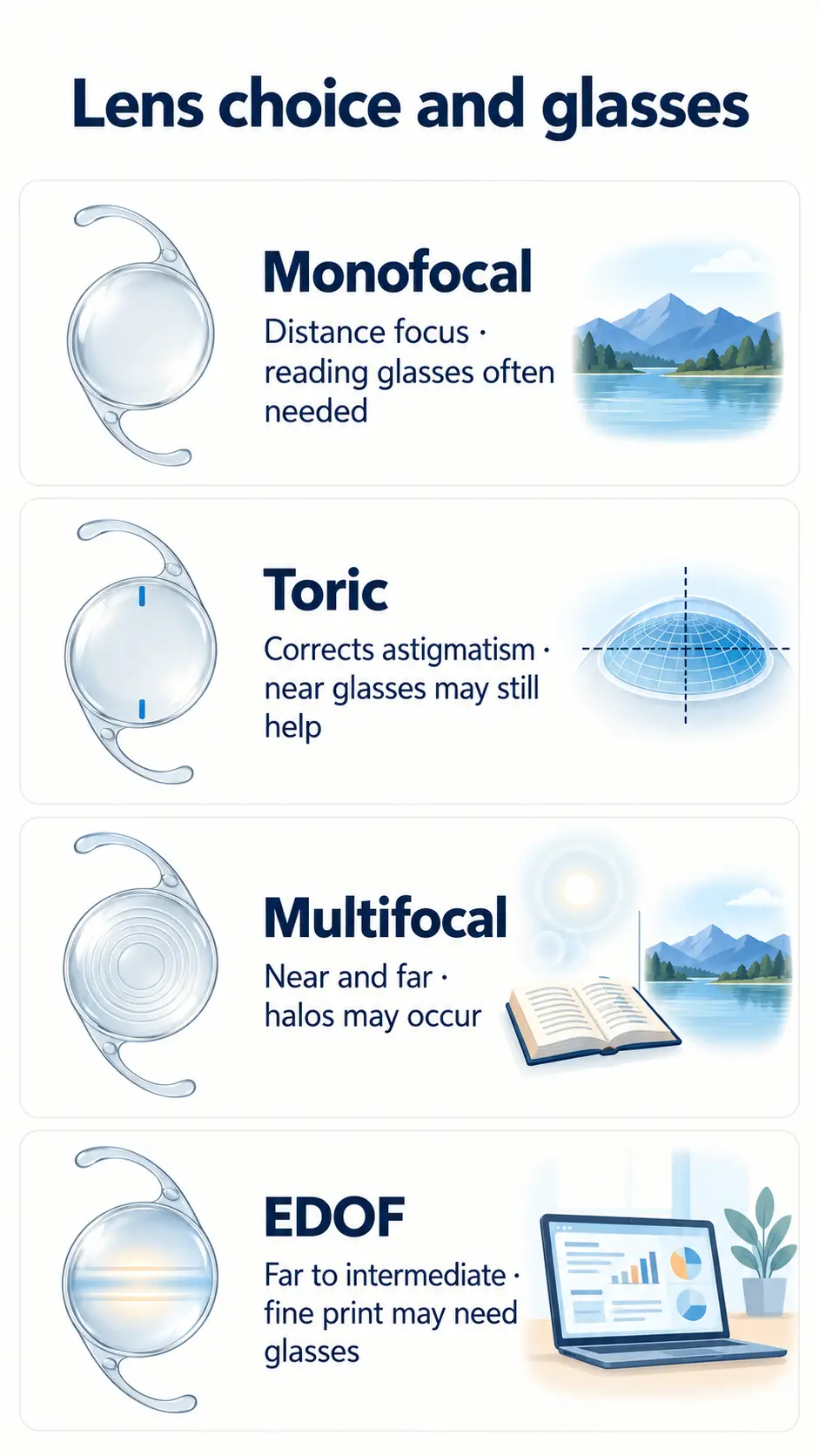
Comparison of monofocal, toric, multifocal, and EDOF lenses, showing their vision focus and potential need for glasses
01

Monofocal lens

A monofocal IOL focuses at one distance. Most people choose to have it set for distance and use reading glasses for near tasks. So you see faces and the TV clearly, but reach for reading glasses after cataract surgery to read your phone.

02

Toric lens

Astigmatism means the front window of the eye (the cornea) is curved unevenly, more like a rugby ball than a cricket ball. A toric IOL corrects astigmatism along with the cataract. Toric IOLs may be considered when clinically significant corneal astigmatism is present.

03

Multifocal lens

A multifocal IOL has rings or zones set at different powers, giving both distance and near focus. Think of one water tank feeding two floors of a house. Both floors get water, but each gets a little less pressure. A multifocal lens shares light between distances in a similar way. That is why some people notice haloes and glare around lights, or find contrast harder to see.

04

EDOF lens

An extended depth of focus (EDOF) lens gives a continuous range from distance to intermediate, such as a computer screen or car dashboard. You may still need reading glasses for fine print.

Some people choose monovision instead. With monofocal lenses, one eye is set for distance and the other for near. It doesn’t suit everyone, so we discuss it carefully.

Lens typeWhat it focuses onWhen you may still need glassesPoints to discuss
MonofocalOne distance, usually farReading and close workSharp at its set distance
ToricCorrects astigmatism tooOften for reading, depending on focus chosenUseful for moderate to high astigmatism
MultifocalDistance and nearLess often, for some tasksGlare or haloes at night, lower contrast for some
EDOFDistance to intermediateFine printReading glasses may still be needed
Monovision (monofocal)One eye far, one eye nearDepends on how well you adaptNot suitable for everyone
“

“Patients sometimes ask me for the most expensive lens. I would rather understand how they spend their day. The right lens is the one that fits your life.”

Dr Geetha Iyer, Medical Director, CODE Eye Care

This is where many people misunderstand premium lenses. A higher-priced lens is not a promise of a life without glasses.

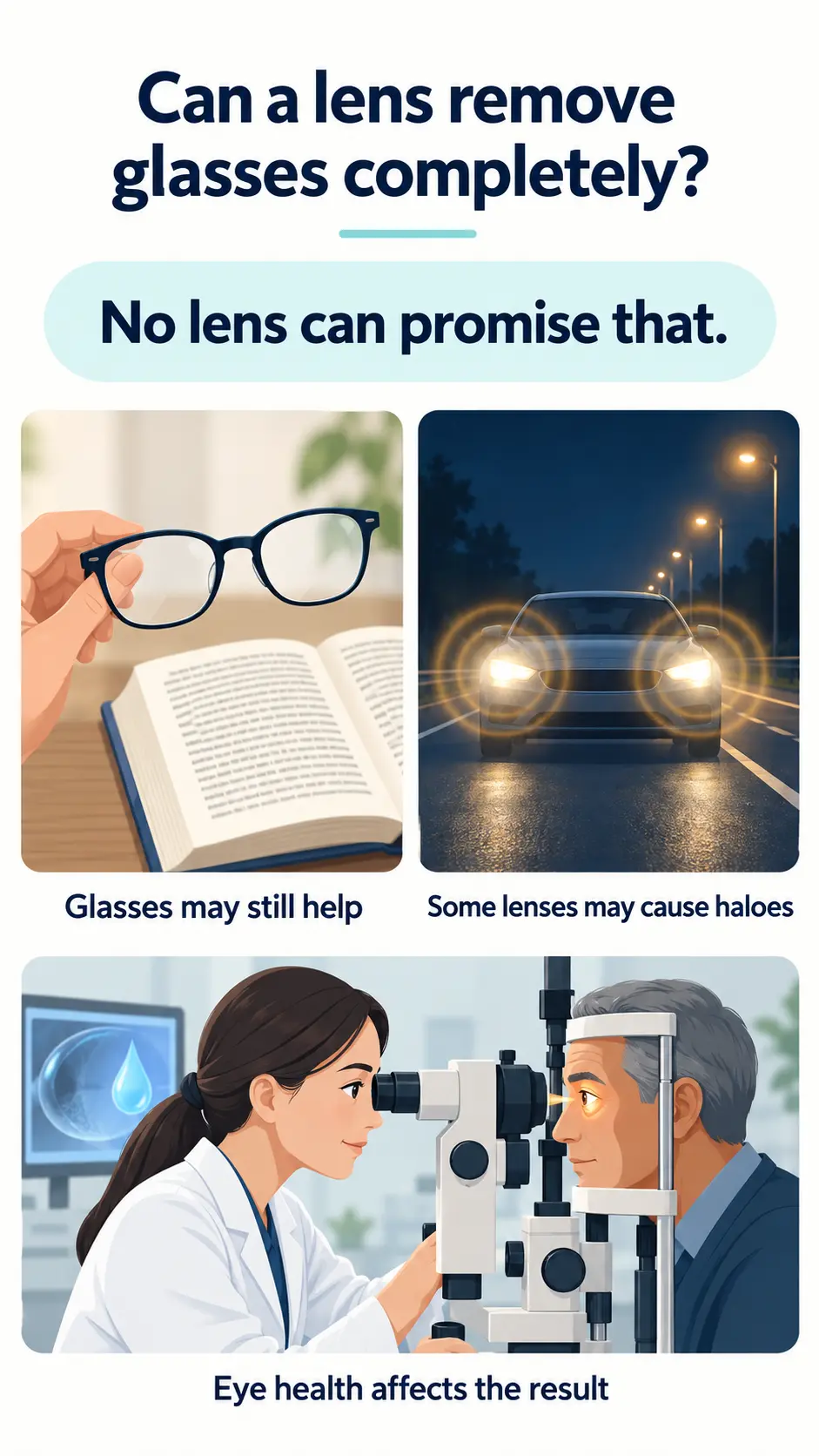
Eye doctor examining a patient after lens surgery, highlighting that glasses may still be needed and some lenses can cause halos
TREATMENT LIMITS

Can Any Lens Promise a Life Without Glasses?

No. No intraocular lens can promise that you will never need glasses after cataract surgery. Multifocal and EDOF lenses reduce dependence on glasses for many people. Yet some still use glasses for certain tasks, and results also depend on the health of the rest of the eye.

A Cochrane review of 20 trials, involving 2,230 people, looked at this question. People with multifocal lenses may be less likely to need extra glasses. But they were more likely to notice glare or haloes, the rings of light around headlights.

The reviewers concluded that the trade-off depends on how much you value being free of glasses.

Your eye health matters too. According to the American Academy of Ophthalmology, people who already have eye disease are more at risk of poor results with these lenses.

As a cornea specialist, I also examine the tear film before we measure the eye. Your lens power is calculated from these measurements. Research shows an unstable tear film can make corneal readings less consistent, which can affect that calculation. So if your eyes are dry, we may treat the dry eye first.

★
KEY TAKEAWAY

“A lens can reduce your need for glasses. It cannot promise to remove it completely.”

So how do we choose? It is one of the first practical questions families ask me.

THE APPROACH

How Do We Decide Which Lens Is Right for You?

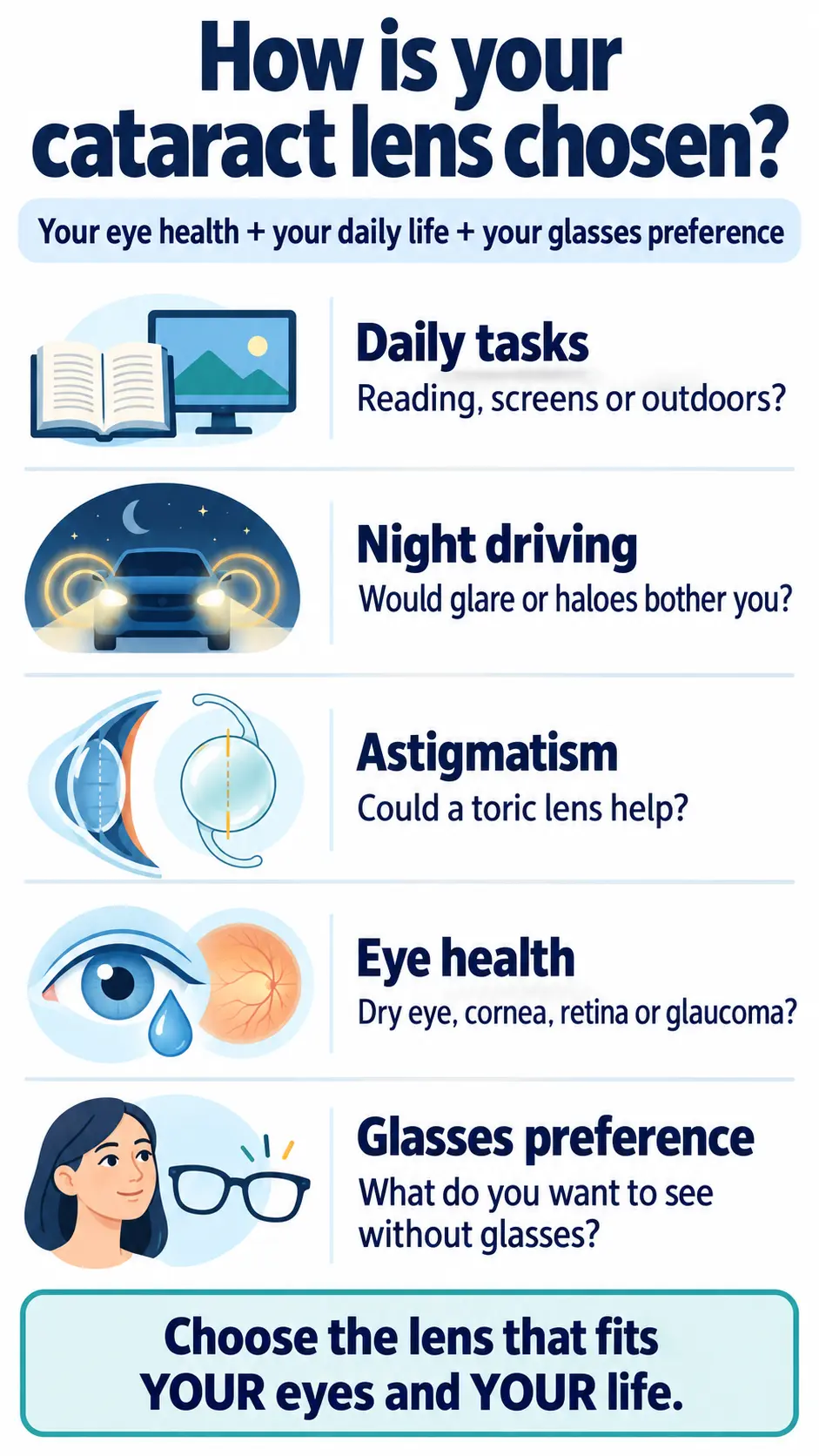
We choose a lens by matching three things: your eye measurements, your eye health, and the way you live. There is no single lens that suits everyone. The right lens matches your needs and trade-offs you can live with.

We go through these questions together:

Infographic explaining how cataract lens choice depends on daily activities, night driving, astigmatism, eye health, and preference for glasses
“

“In my practice, the most useful question is not ‘Which lens should I take?’ It is ‘What would you like to see without glasses?’”

Dr Geetha Iyer, Medical Director, CODE Eye Care

This is also why we believe in personalised cataract care rather than one package for everyone.

Once you choose a lens and have surgery, timing matters.

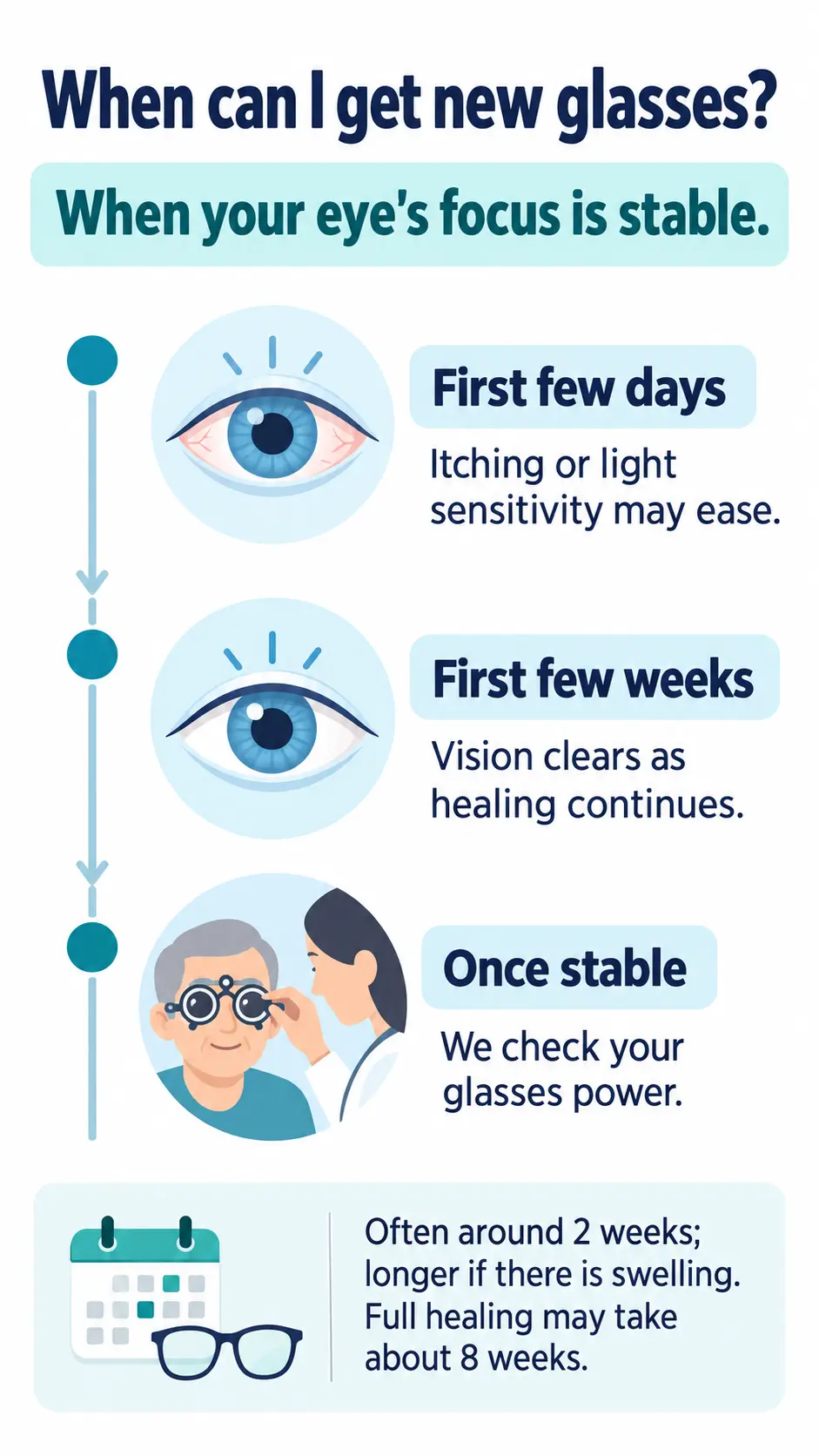
Illustration explaining when to get new glasses after eye surgery, showing vision stabilization during the first few days and weeks and a glasses power check once the eye heals
THE TIMELINE

When Can You Get New Glasses After Cataract Surgery?

However, the time differs from person to person. Final glasses are usually prescribed once the eye has healed and the refraction is stable, often after a few weeks.

You can get new glasses after cataract surgery once we confirm your eye’s focus is stable. According to the American Academy of Ophthalmology, this takes about two weeks on average, but it can take longer if there is swelling. Most people are completely healed about 8 weeks after surgery.

“Doctor, can I just buy new glasses next week?”

I usually ask patients to wait. Think of a newly laid cement floor. You let it set before you place the heavy almirah on it.

Stage 1: The first few days. Your eye may feel itchy and sensitive to light. Mild irritation, watering or light sensitivity may occur during the early postoperative period and usually improves as the eye heals.
Stage 2: The first few weeks. Vision becomes clearer as the eye heals. Full settling usually takes 2 to 4 weeks, and longer if the cornea is swollen.
Stage 3: Once stable. We check your refraction, the test that measures your exact glasses power, and prescribe glasses if needed.
!
IMPORTANT

After cataract surgery, call your eye doctor right away if you notice vision loss or a very red eye. Also call if pain does not settle with medicine, or you see new flashes or floaters.

This timeline is simple once both eyes are done. It can feel stranger when only one eye has had surgery.

BETWEEN SURGERIES

Why Does Vision Feel Unbalanced When Only One Eye Cataract Operation Is Done?

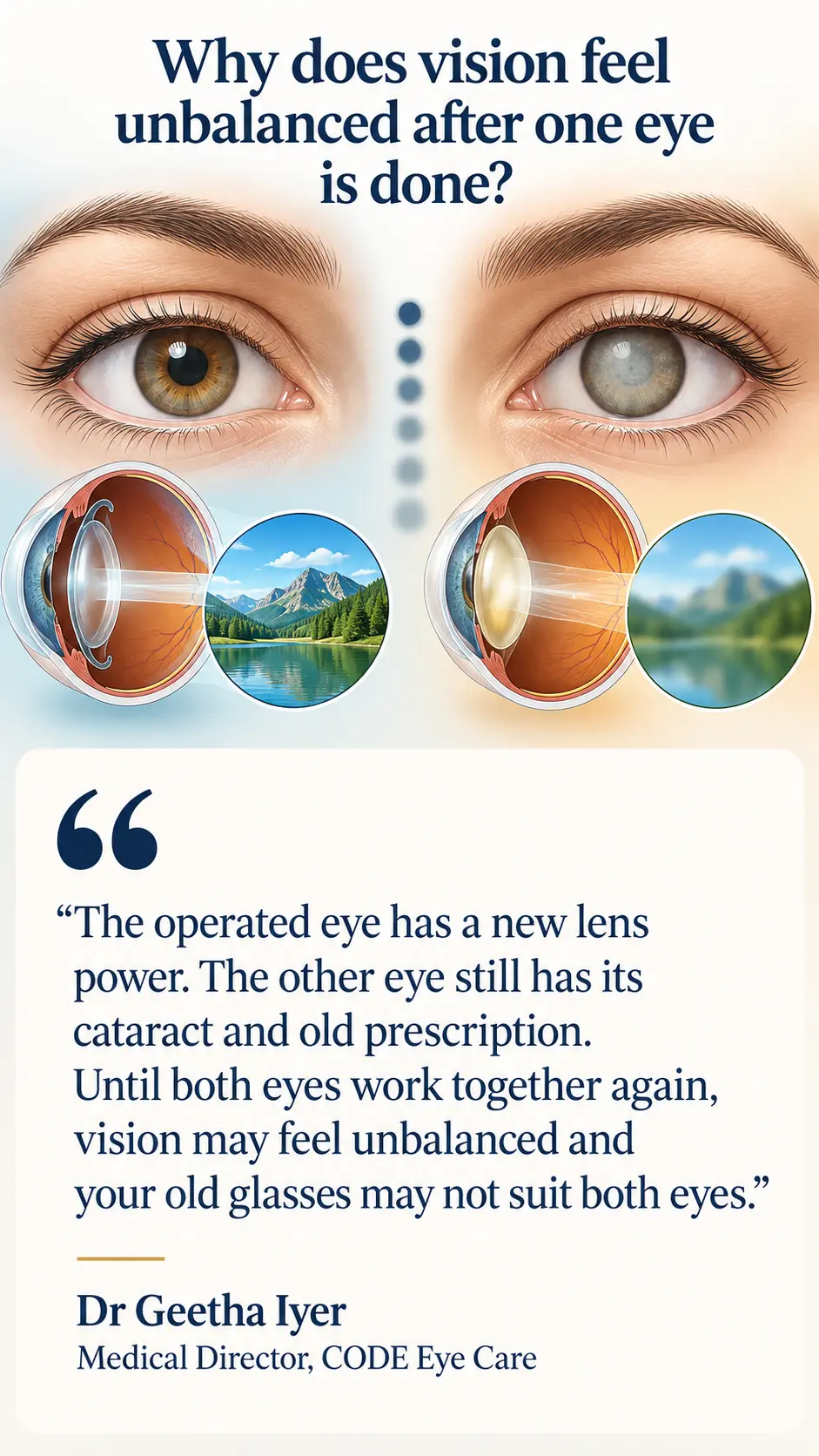
Vision can feel unbalanced after surgery on one eye because the two eyes suddenly focus differently. The operated eye has a new lens with a new power. The other eye still has its cataract and old prescription, so your old glasses may no longer suit both eyes.

A large difference in power between the two eyes is called anisometropia. People who were nearsighted (myopic) before surgery often notice it most.

“Doctor, my distance is so clear now. Why can’t I read the newspaper?”

Until the second eye is done, one option is simple reading glasses for close work. How you manage between the two surgeries depends on the refractive target chosen for the operated eye. Please ask us before choosing a power. This phase is temporary.

Illustration showing unbalanced vision after cataract surgery in one eye, with different lens powers and blurred vision in the untreated eye

Even after both eyes settle and new glasses are made, some people notice a change months or years later.

THE FOLLOW-UP

“Doctor, It Was So Clear. Why Is It Hazy Again?”

Haze that returns after cataract surgery can be due to posterior capsule opacification (PCO), often called a secondary cataract. The cataract has not grown back. Instead, the thin capsule holding your new lens has become cloudy, and a short laser treatment can clear it.

Picture the clear protective film on a new mobile phone screen that slowly turns hazy. The phone underneath is fine. Only the film needs attention.

The treatment is called YAG laser capsulotomy. A laser makes an opening in the cloudy capsule so light passes through clearly again. It is usually a brief outpatient laser procedure.

New glasses will not clear PCO haze. Not every blur is a power change, as I explain in why eye power changes. If your vision fades, get your eye checked before changing your glasses.

Along the way, patients bring many beliefs about glasses and cataract surgery. Some are true. Many are not.

MYTHS VS FACTS

What Are the Common Myths About Glasses After Cataract Surgery?

The most common myth is that cataract surgery always ends the need for glasses. In reality, glasses after cataract surgery depend on your lens type and eye health. Many people still use them for some tasks.

MYTH

Cataract surgery will make me completely free of glasses.

FACT

With a monofocal lens, reading glasses are usually needed. Multifocal and EDOF lenses reduce, but do not always remove, the need for glasses.

MYTH

If my vision blurs again, the cataract has come back.

FACT

The removed lens cannot grow back. Later blurring may be PCO, which is treated with a quick laser procedure.

MYTH

Needing glasses after surgery means the operation failed.

FACT

Reading glasses after a monofocal lens are an expected part of the plan, not a sign of failure.

You may still have a few specific questions. These are the ones I hear most often.

ANSWERS

What Do Patients Commonly Ask About Glasses After Cataract Surgery?

Will I need reading glasses after cataract surgery?

Yes, most likely, if you choose a monofocal lens set for distance. Reading glasses after cataract surgery are then usually needed for close work, like reading or using a phone. Multifocal lenses may reduce this need, while EDOF lenses may still need readers for fine print.

It depends. Driving without glasses depends on the focus of your new lens and how well your eye has healed. Your ophthalmologist will check your vision and tell you when it is safe to drive, and whether you need glasses for it.

Not necessarily. A toric lens can correct astigmatism along with the cataract and reduce your dependence on cylindrical glasses. You may still need reading glasses, depending on the focus chosen for your new lens.

Not always, but they can help. Your eye may feel sensitive to light for the first day or two after cataract surgery, so dark glasses can make you more comfortable outdoors.

Not usually. Once the eye has healed after cataract surgery, the power of the artificial lens itself stays the same. However, dryness or PCO can still affect clarity, so regular eye examinations remain important.

GI

A Note from Dr Geetha Iyer

Medical Director, CODE Eye Care, Chennai

“Many patients come to me having already decided on a lens, often because a neighbour’s lens removed all their glasses. Others worry they will be pushed into something they don’t need.”

The common mistake is to start with the lens. I prefer to start with your eye.

Let us first look at your whole eye: the cornea, the tear film, the retina and the optic nerve. Then let us talk about your day. How much do you read? Do you drive at night? Do you mind reading glasses?

Some people will still need glasses for some tasks, whichever lens they choose. That is not a failure. It is an honest outcome, and I would rather tell you now than surprise you later.

But with the right lens and a well-prepared eye, daily life often becomes easier. So bring your questions, and bring your family. We will decide together.

Final Thoughts

If you’ve searched “do we need glasses after cataract surgery,” you are probably hoping for a simple yes or no.

The real answer is that many people still use glasses for some tasks. How often depends on your lens, your eye health and the way you live.

The encouraging part is that you have choices, and we can plan your surgery around what matters most to you.

Clear vision comes first. Less dependence on glasses is something we plan together.

When Should You See a Cataract Specialist?

See a cataract specialist if your vision is cloudy, colours look faded, headlights seem too bright, or your glasses power keeps changing. These symptoms should not simply be dismissed as part of ageing.

At your visit, we examine your whole eye, take detailed measurements and talk through the lens options that suit your daily life.

If you are considering cataract surgery in Chennai, you can schedule a comprehensive eye examination with our team.

Last reviewed: September, 2026 by Dr Geetha Iyer, Medical Director, CODE Eye Care.

This article is for general information and does not replace a personal eye examination.

Related patient education
More from CODE Insights.
Common Myths About Eye Power Changes: Facts vs. Fiction

Common Myths About Eye Power Changes: Facts vs. Fiction

Common Myths About Eye Power Changes: Facts vs. Fiction Are You Believing These Eye Power Myths? Many misconceptions exist about […]
Why Does Your Eye Power Change? Causes and Solutions

Why Does Your Eye Power Change? Causes and Solutions

Why Does Your Eye Power Change? Causes and Solutions Why Does Your Eye Power Change? Have you ever wondered why […]

Top 10 Mistakes Contact Lens Wearers Make & How to Avoid Them

Top 10 Mistakes Contact Lens Wearers Make & How to Avoid…

Top 10 Mistakes Contact Lens Wearers Make & How to Avoid Them Are You Wearing Contact Lenses the Right Way? […]

Scroll to Top

Book an Appointment

Contact us